
SKNK Technical Guide
What Is IPv4? Addresses, Subnets, Exhaustion, and Why Networks Still Use It
What is IPv4? How 32-bit addresses work, what a /24 really measures, why the pool ran out, and why networks still run on IPv4 through NAT, leasing, CIDR, and dual-stack.
Technical content
Written and maintained by Shikanoko NetworksThe ticket usually reads the same way: new server, needs a public IPv4 address, deadline Friday. Then the follow-up questions arrive faster than the answers. Is a /24 the same thing as 256 addresses? Is the /25 in that leasing quote a bargain or a trap? Do you need an ASN for this, a ROA, or neither? And if the pool ran dry years ago, what exactly are all those marketplaces still leasing?
Each of those questions quietly mixes four different layers: addressing, subnetting, routing, and commercial arrangement. This article takes them apart in that order. BGP configuration is out of scope — it appears only far enough to show where addressing ends and routing begins.
Definition Box: IPv4 (Internet Protocol version 4) is the network-layer protocol that remains widely deployed across the Internet. Every packet is delivered toward a 32-bit address, written in dotted decimal as
192.0.2.1. Within a given network context, that address usually identifies one network interface — not a prefix, not a route, and not a company.
1. What IPv4 Actually Is
IPv4 has two jobs: put a destination address on a packet, and let each router along the path decide where to forward it. Defined in RFC 791 in 1981, it does this with a small header and no promises — delivery is best-effort, with no guarantee that a packet arrives, arrives once, or arrives in order. Reliability is handled above it, by TCP.
Everything distinctive about IPv4 follows from one design decision: the address is 32 bits long, giving 2 to the power of 32 — 4,294,967,296 — possible addresses. In 1981, connecting a few hundred research institutions, that looked unspendable. It also set the ceiling that subnetting, NAT, and leasing markets all exist to work around.
2. What an IPv4 Address Looks Like
Those 32 bits are written as four numbers separated by dots — each number one octet, 8 bits, running from 0 to 255:
192.0.2.1
= 192 . 0 . 2 . 1
= 11000000 . 00000000 . 00000010 . 00000001
In practice the bits split into two roles: a network part, which says which network the address belongs to, and a host part, which says which host on that network. Where the split falls is not written into the address — that is what the prefix length declares, and it is the single most important idea on this site. What Is an IP Prefix? covers it in depth.

One IPv4 address is 32 bits: four octets of eight bits, written as four decimal numbers between 0 and 255.
3. Address, Prefix, Route, and Announcement: Four Different Questions
Most confusion around IPv4 comes from treating four distinct objects as one:
| Concept | The question it answers |
|---|---|
| IPv4 address | Which address does this one interface use? |
| IPv4 prefix | Which range of addresses does this block cover? |
| Route | Where should traffic targeting that range be sent? |
| BGP announcement | Which network is currently declaring a path to that range? |
You can hold an address without announcing it, announce a range you do not hold, and hold a valid prefix whose route nobody propagates. Each row can be true or broken independently — a theme that repeats all the way down this article.
4. Public IPv4, Private IPv4, and NAT
Not every IPv4 address is visible on the Internet. Three situations cover almost everything you will meet:
| Public IPv4 | Private IPv4 (RFC 1918) | NAT | |
|---|---|---|---|
| Examples | 203.0.113.7 |
10.0.0.0/8, 172.16.0.0/12, 192.168.0.0/16 |
One public address in front of many private ones |
| Routable on the Internet? | Yes, when a route exists | No — reserved for internal use | Only the shared public side |
| Who uses it | Servers, routers, anything that must be reached | Every LAN, office, and home network | Homes, mobile carriers, cloud defaults |
Three misconceptions cost real money here:
- Private addresses are not "low-quality public addresses." They are reserved, reusable space.
192.168.1.1exists in millions of networks at once, by design — that is what keeps the numbering system alive. - NAT solves address reuse, not public reachability. A billion devices hide behind a shrinking pool of public addresses, but a device behind NAT is not reachable from outside until something explicitly opens the door.
- Holding a public address does not make you globally reachable. Reachability is a property of routing: no announced, accepted, propagated route, no visitors — even if the address is indisputably yours.
5. CIDR, Subnets, and What /24 Measures
The old classful system (Class A, B, C) wasted enormous space by allowing only three fixed split points. CIDR replaced it in the early 1990s: the split between network and host parts can fall on any bit boundary, written as the prefix length after the slash.
| Prefix | Addresses in the block | Typical use |
|---|---|---|
/8 |
16,777,216 | Legacy allocations, entire carriers |
/16 |
65,536 | Large enterprise blocks |
/24 |
256 | A common practical boundary for broad IPv4 propagation |
/32 |
1 | One single address |
One rule holds across all of them: the longer the prefix, the smaller the range. A /25 is exactly half of a /24 — 128 addresses. And "256 addresses" describes the block, not usable servers: as a LAN subnet, a /24 burns its first and last addresses as network and broadcast addresses, leaving 254 assignable hosts. The exact mechanics live in What Is an IP Prefix?.

The prefix length pins down the first N bits: more bits pinned, fewer addresses free — and each extra bit halves the range.
6. Why /24 Keeps Coming Up in Global Routing
If you have read anything about BGP, you have met the /24 threshold. What is actually true is narrower than the folklore:
- Many networks apply prefix-length filters to IPv4 and decline anything more specific than
/24— a/25or/26, that is. - As a result,
/24operates as the common practical boundary in global IPv4 routing: the most-specific length you can usually rely on being propagated widely. - A
/25can be configured and announced in BGP without complaint from your router. Whether anyone beyond your upstream accepts it is decided by every network in the path.
So "can be announced" and "will be globally visible" are different claims, made by different people — and only the first one is yours to make. IPv4 Leasing Below /24 dissects exactly this gap; How to Announce an IPv6 /48 via BGP shows the same chain of conditions in the IPv6 world.
7. Why IPv4 Ran Out
The arithmetic was never kind: 4.29 billion addresses against a planet connecting several billion phones, plus every server, router, and camera. The milestones came in sequence. In 2011, IANA allocated the last free /8 blocks to the Regional Internet Registries. Through the following years, each RIR in turn exhausted what it could hand to members — RIPE NCC, the registry for Europe, the Middle East, and parts of Central Asia, announced its pool was spent in 2019.
Since then, supply has been an aftermarket. Addresses are leased (contracted use for a term), transferred (moved permanently under registry policy), recovered from dormant allocations, and reused harder through NAT and CGNAT, where entire subscriber bases share one public address — the 100.64.0.0/10 range exists specifically for that. None of this prints new addresses; it changes who holds them and how intensively they are used.
Four acronyms are enough orientation: IANA holds the global pool; RIRs divide it by region; LIRs (like SKNK) hold and distribute resources within a region, sponsoring end users through the registry; end users hold the right to use resources via one of those relationships. That is the whole hierarchy this article needs.
8. Where Addresses Come From — and What "Owning" One Means
"Getting IPv4" means different things depending on where it comes from, and the differences surface the day you try to leave:
| Source | What you actually receive |
|---|---|
| ISP provides | A right to use addresses with your connectivity — leave the ISP, renumber |
| Cloud provider | Addresses bound to cloud resources — released when the resource goes |
| IPv4 lease | Contracted use for a fixed term — the registration stays with the holder |
| PI space | Independent, registry-recorded resources you administer more directly |
| PA space | Allocation under an LIR's umbrella — tied to that relationship |
Boundaries worth stating plainly: an ASN does not come with IPv4 addresses, and holding neither grants the other. A lease does not transfer ownership. Being able to announce a prefix in BGP says nothing about whether the resource may migrate with you later. Before committing, check four things separately — the contract, the RPKI records, the IRR objects, and the upstream's authorization — because each can independently void what the other three promise.
9. How IPv4 Reaches the Global Table
An address becomes reachable through a chain of independent steps:
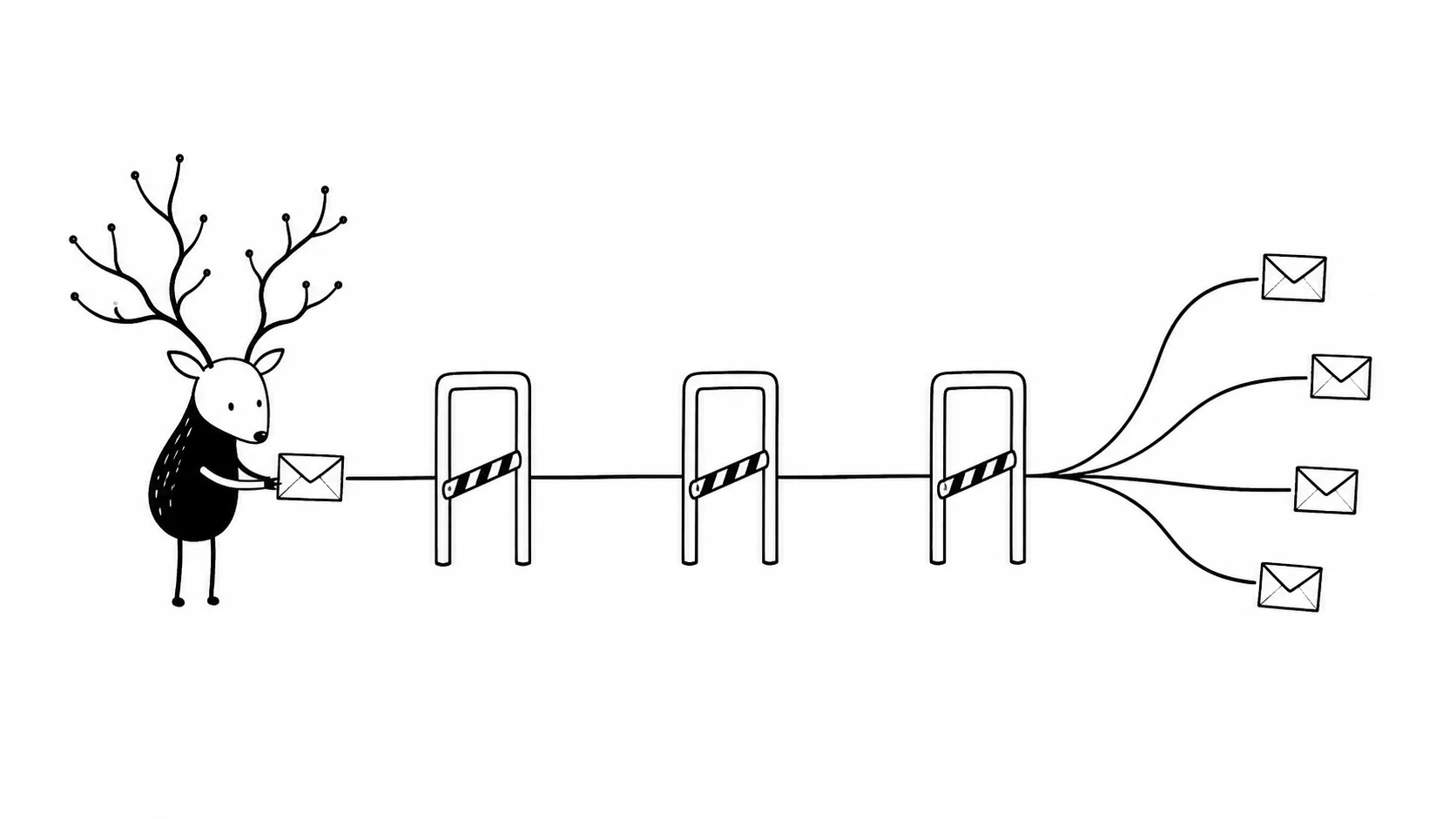
From address resource to global visibility: authorization records, router configuration, and upstream filtering each decide separately whether the route travels on.
- The resource exists — a prefix you hold, lease, or receive from an LIR.
- Authorization is recorded — a ROA declares the intended origin ASN; an IRR route object records routing intent for filters to consult.
- BGP announces it — your router configuration, under your ASN, exports the prefix upstream.
- Upstreams filter and accept — each network applies its own combination of ROA, IRR, prefix-length, and local-policy checks before propagating.
- The route spreads and becomes observable in looking glasses and route collectors.
Five roles, no redundancy in the set: the IPv4 address is the resource, the ASN is the network identity, BGP is the exchange mechanism, the ROA is the origin authorization, and the IRR route object is the filter reference. A failure at any layer — an expired ROA, a missing route object, an over-specific prefix, a strict upstream — can quietly cap your visibility while everything else looks healthy.
One note on roles: SKNK provides ASN sponsorship and IPv6 PA /48 allocations, including RPKI ROA management for SKNK PA resources. SKNK does not sell IPv4 with a guarantee of global routing, and does not operate BGP on behalf of customers — upstream selection and router configuration remain yours unless separately agreed in writing.
10. IPv4 and IPv6, Side by Side
| IPv4 | IPv6 | |
|---|---|---|
| Address length | 32 bits | 128 bits |
| Address count | ~4.3 billion | Vastly more than needed |
| Notation | Dotted decimal — 192.0.2.1 |
Hexadecimal — 2001:db8::1 |
| NAT dependence | Widespread, structural | Typically little to none |
| Address supply | Exhausted; aftermarket pricing | Still ample for new allocations |
| Common routing granularity | /24 as the practical boundary |
/48 allocations, /64 per LAN |
| Migration path | Keep running, reuse harder | Dual-stack, then gradual transition |
Neither extreme is true: IPv6 is not "faster," and IPv4 is not about to vanish. The realistic picture is both protocols running side by side for years — What Is IPv6? covers the other side of that table.
11. Six Misconceptions Worth Correcting
- "An IPv4 address and an IPv4 prefix are the same thing." An address is one endpoint; a prefix is a range. Announcements, ROAs, and leases all operate on prefixes.
- "With a public IPv4 address, the world can reach me." Only if a route to it is announced, accepted, and propagated. The address is necessary, not sufficient.
- "Having an ASN means I own IPv4 space." An ASN is a routing identity. It grants no addresses, and address holdings grant no ASN.
- "A /25 can never be announced via BGP." It can be configured and announced. What is not guaranteed is propagation past prefix-length filters — visibility is each transit network's decision.
- "My ROA is Valid, so my route works everywhere." A Valid ROA passes origin validation. It does not waive prefix-length filters, policy, or a broken session downstream.
- "IPv6 exists, so IPv4 has no value now." IPv4 remains widely deployed, leased addresses carry real market pricing, and dual-stack means running both well — not abandoning either.
FAQ
How many IPv4 addresses are there in total?
4,294,967,296 — 2 to the power of 32. Many ranges are reserved for private, multicast, documentation, and other special purposes and do not appear as ordinary public Internet addresses.
Is 192.168.1.1 a public address?
No. 192.168.0.0/16 is RFC 1918 private space. The same address legitimately exists in millions of private networks simultaneously — that is its purpose.
What is the difference between /24 and /25?
Size, and nothing else: a /24 covers 256 addresses, a /25 half of that. In global routing the difference is not cosmetic — /25 is more specific than the boundary many networks filter at.
Can IPv4 addresses be leased?
Yes. A lease grants contracted use of a registered block for a term, priced by the market since the registries ran out. The registration normally stays with the holder throughout.
After leasing IPv4, can I announce it with my own ASN?
At the BGP layer, a lease may allow it, but only if the resource holder or provider authorizes your ASN and can create matching ROA and IRR records. A router can be configured to announce the prefix, but that configuration does not create authorization. Whether the announcement propagates globally still depends on prefix length and each network's filters.
Can IPv4 and IPv6 be used at the same time?
Yes — that is the standard operating mode, called dual-stack. One server holds an address in each family and serves both; each client uses whichever it has.
Why is NAT still everywhere?
Because it turned one public address into a whole network's connectivity, and because public IPv4 now costs real money. NAT persists for economics, not elegance.
Will IPv4 disappear completely?
Not on any schedule worth betting on. Expect a long, uneven decline in relative share while IPv6 adoption rises — both protocols coexisting for the foreseeable future.
Key Takeaways
- IPv4 is a 32-bit, best-effort network-layer protocol; one address names one interface.
- Address, prefix, route, and BGP announcement answer four different questions and fail independently.
- Private space and NAT stretch scarce public addresses by design — they are not second-class addresses.
- The longer the prefix, the smaller the range;
/24is the practical boundary of broad IPv4 propagation, not a law of physics. - Exhaustion created an aftermarket — leasing, transfers, reuse — layered over IANA → RIR → LIR → end user.
- Reachability is a chain, and any link can fail alone.
In One Sentence
IPv4 is the 32-bit addressing system the Internet still runs on — but who holds an address, how wide its prefix is, whether BGP announces it, and whether the world can actually reach it are four separate questions.
Continue Reading
- What Is an IP Prefix? — the range notation every IPv4 block is written in.
- What Is an ASN? — the network identity behind your announcements.
- What Is a ROA? — the record that declares your intended origin.
- IPv4 Leasing Below /24 — what a sub-
/24lease actually gets you. - What Is IPv6? — the other side of the address-space story.
- How to Announce an IPv6 /48 via BGP — the launch chain, end to end.