
What Is Multihoming? Why One Internet Connection Isn't Enough
Learn what multihoming is, why networks connect to multiple Internet providers, how BGP makes it possible, and the trade-offs between redundancy, performance, and cost.
What Is Multihoming? Why One Internet Connection Isn't Enough
Introduction
If your Internet provider has an outage, what happens to your network?
For a home connection, the answer is simple: wait until the ISP fixes it. Maybe you tether through your phone for a while. Annoying, but survivable.
For a business, the answer is different. Downtime costs money — lost sales, broken APIs, angry customers, SLA penalties. A single severed fiber line on a provider's backbone can take a whole office offline for hours.
So the question stops being "should the Internet work?" and becomes "what happens when one connection fails?"
The answer to that question is multihoming.
Definition Box
Multihoming — connecting a network to two or more upstream providers so it can continue reaching the Internet if one connection becomes unavailable.
Upstream Provider — an Internet service provider that offers transit to another network, carrying its traffic toward the rest of the Internet.
What Is Multihoming?
At its core, multihoming is one idea:
One network.

↓

Multiple Internet providers.

↓

One routing policy.
You own a single network — your AS (autonomous system), your IP prefixes, your routers. Instead of plugging that network into just one transit provider, you plug it into two or more. If one provider's path to the Internet breaks, traffic simply leaves through the other.
Here is the simplest picture:

If one upstream path fails, traffic can continue through the surviving provider.
Your network sits in the middle. Two providers hang off the sides. As long as at least one link is up, you are still on the Internet. That is the entire concept. Everything else in this article is detail built on top of that shape.
Why One Internet Connection Isn't Always Enough
This is the most important section, because it explains why anyone would pay for a second connection at all.
The question people actually ask is: why would I pay for two transit contracts when one already works?
The answer is not technical. It is commercial. A single provider is a single point of failure, and failures are more common than they feel:
- ISP outage — the provider's own network has an internal fault, a bad config push, or a regional meltdown.
- Fiber cut — a construction crew digs through a backbone cable. This happens constantly in the real world.
- Upstream maintenance — your provider's upstream may take its own link down for planned work, and you inherit the outage.
- DDoS — an attack saturating one transit link does not take down a second, separate path.
- Regional failure — a power outage, a flood, or a peering dispute can knock out an entire geography for one operator while leaving another intact.
None of these are exotic. They are ordinary events that any network operator will encounter over time. A home user shrugs and refreshes the page. An enterprise that loses its only link loses revenue for every minute it stays dark.
Multihoming exists because the cost of one more connection is usually far smaller than the cost of one more hour offline.

A second provider is insurance against a failed path—not an automatic promise of more bandwidth.
How Multihoming Works
Now we reach the technical layer, and this is where BGP enters.
Each provider gives your router a view of the Internet — a set of routes describing how to reach every destination. Your router also tells each provider about your own prefixes. The exchange looks like this:

BGP learns multiple reachable paths, then routing policy chooses the path used for a destination.
You advertise your prefix to both providers, so the rest of the Internet knows it can reach you through either one. You receive routes from both providers, so your router knows how to reach the rest of the Internet through either one. Then your router picks the best path for each destination according to policy.
We will not open up the "best path" decision here — that is its own topic. The key point for this article is simpler: multihoming works because your network can be reached and can reach out through more than one door. That single fact is what turns a second connection from "extra cost" into "insurance" — which is exactly why it matters.
Why It Matters
Now that you have seen how multihoming works, the natural question is: what do you actually get from it? The answer is not "a faster Internet." It is control over whether you stay connected at all. The value breaks down into three layers, in order of how often they matter.
Resilience (the reason most networks start here)
If one line breaks, you stay online through the other. A fiber cut, an ISP outage, a regional failure — none of them take you fully dark, because traffic simply reroutes through the surviving path. This is the headline benefit, and for most organizations it is the entire justification.
Control (independence from any one vendor)
You are no longer at the mercy of a single provider's pricing, policy, or support quality. If one raises rates or degrades service, you have leverage: you can shift traffic to the other. Multihoming turns a captive relationship into a negotiable one.
Performance (conditional, not guaranteed)
Sometimes, different destinations are closer through different providers, and a multihomed network can send each flow out the door that reaches its destination fastest. But this is a bonus, not the core promise — and it only appears when you actively steer traffic. Do not adopt multihoming expecting it to make everything faster; adopt it so you stay up when one path fails. We will connect this steering to path selection in a later guide.
Single-Homed vs Multihomed
After seeing the value, the difference between the two approaches is easiest to see side by side:
| Dimension | Single-Homed | Multihomed |
|---|---|---|
| Providers | One | Two or more |
| Redundancy | Limited | High |
| Cost | Lower | Higher |
| Complexity | Low | Higher |
| Typical Users | Small sites, homes | Enterprises / ISPs / CDNs |
Single-homed is cheaper and simpler. Multihomed costs more and demands more operational skill — but it removes the single point of failure.
Common Ways to Deploy Multihoming
Real networks combine multihoming with other building blocks. A few common deployment shapes:
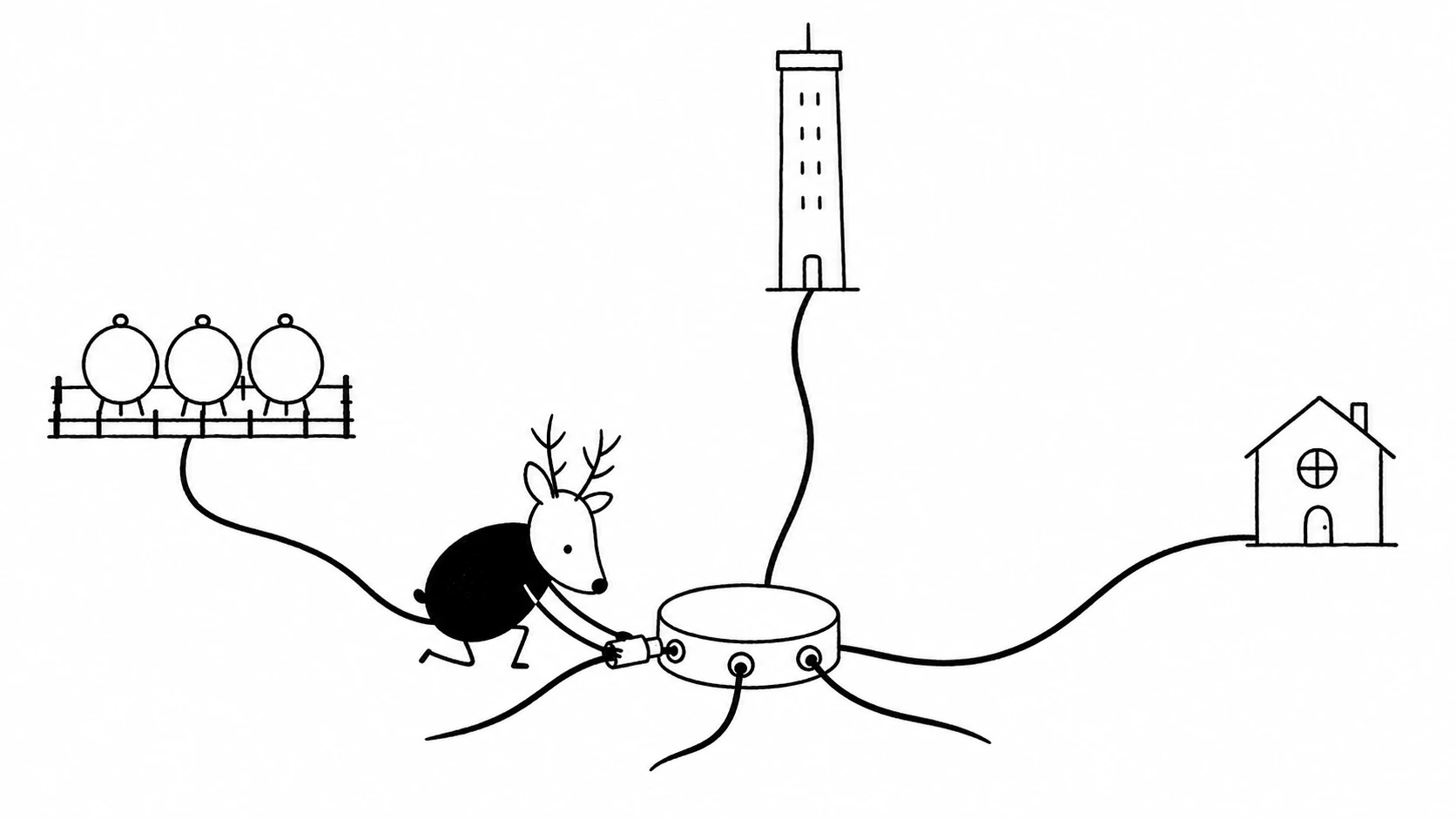
Multihoming is a building block: operators can combine several external paths in different deployment designs.
Dual Transit
The classic form: two transit providers, one router (or router pair). Simple and effective.
Transit + IXP
One paid transit provider plus a connection to an Internet Exchange Point, where you peer directly with many networks for free or cheap. Common for cost-conscious operators.
Two Data Centers
Two sites, each multihomed, connected and coordinated through BGP. Used by larger operations that need site-level redundancy on top of link-level redundancy.
This section is not exhaustive. The real world has many combinations — the point is that multihoming is a building block, not a single fixed design.
The Role of BGP
Multihoming is possible because of BGP.
Without a routing protocol that lets independent networks exchange reachability information, you could not announce your prefix to two providers and receive routes from both. BGP is the mechanism that makes "reachable through either door" a real, working state on the global Internet.
We will keep this brief on purpose:
BGP determines which path is preferred according to routing policy.
We are not unpacking the decision process here — that is the subject of the next guide. For now, remember the cause-and-effect: no BGP, no multihoming.
Common Misconceptions
Myth: Multihoming doubles your Internet speed.
It does not. You do not bond two providers into one fatter pipe by default. Each flow still uses one path. You gain resilience and choice, not automatic doubling of bandwidth.
Myth: Multihoming means load balancing.
Not necessarily. Many multihomed networks use one provider as primary and the other as backup only. Load balancing is a policy choice you can make, not a guaranteed behavior.
Myth: Two ISPs means zero downtime.
No. Your own router can fail. Your data center can lose power. A fiber into your building can be cut. Multihoming removes the provider as a single point of failure — it does not make failure impossible.
Do You Need Multihoming?
Three quick buckets:
Probably No
- Personal website
- Blog
- Small VPS
A single connection is fine. The cost of downtime is low.
Maybe
- SaaS
- Growing business
Worth considering as uptime starts to matter to customers and revenue.
Probably Yes
- ISP
- CDN
- Cloud provider
- Enterprise network
Downtime is expensive or unacceptable, and you have the operational skill to run BGP.
Key Takeaways
- Multihoming means connecting a network to multiple upstream providers.
- It improves resilience rather than guaranteeing higher speed.
- BGP enables a multihomed network to choose between available paths.
- Multihoming increases operational complexity as well as redundancy.
- Many enterprises and network operators use multihoming to reduce dependency on a single provider.
In One Sentence
Multihoming connects a network to multiple Internet providers, improving resilience and routing flexibility through BGP.
FAQ
Do I need my own ASN?
Yes. To multihome properly you need your own ASN so you can announce your prefix to multiple providers as one consistent network. See What Is an ASN? for the details.
Can I multihome without BGP?
Usually no. BGP is the protocol that lets you announce and receive routes from multiple providers. Some narrow workarounds exist (like relying on a single upstream that itself multihomes), but true multihoming requires BGP.
Does multihoming improve speed?
Sometimes, not always. It can improve performance by letting you pick the better path per destination, but it does not automatically double your bandwidth.
Is multihoming expensive?
It depends. You pay for multiple transit contracts and the gear to run BGP. For a small site it is often hard to justify; for an enterprise the cost of downtime usually dwarfs the cost of the second link.
How many providers should I use?
Usually two. Two removes the single point of failure without the complexity and cost of three or more. More providers are added only when specific needs demand it.
Continue Reading
A complete learning path through the SKNK Learning Center:
- Transit vs Peering: What's the Difference? — understand why networks need upstream connections at all.
- What Is an Internet Exchange (IXP)? — learn how direct interconnection complements transit.
- BGP Basics: How the Internet Learns Where to Send Traffic — the foundational protocol behind multihoming.
- BGP Path Selection Explained: How Routers Choose the Best Path (next) — go deep on how multiple paths are ranked and selected.
- What Is RPKI? — learn how to protect your route announcements in a multihomed world.
Ready to get your own ASN?
Full RIPE NCC LIR sponsorship — ASN + /48 IPv6, one flat fee. RIPE NCC compliant, UK-based LIR.
See Pricing →